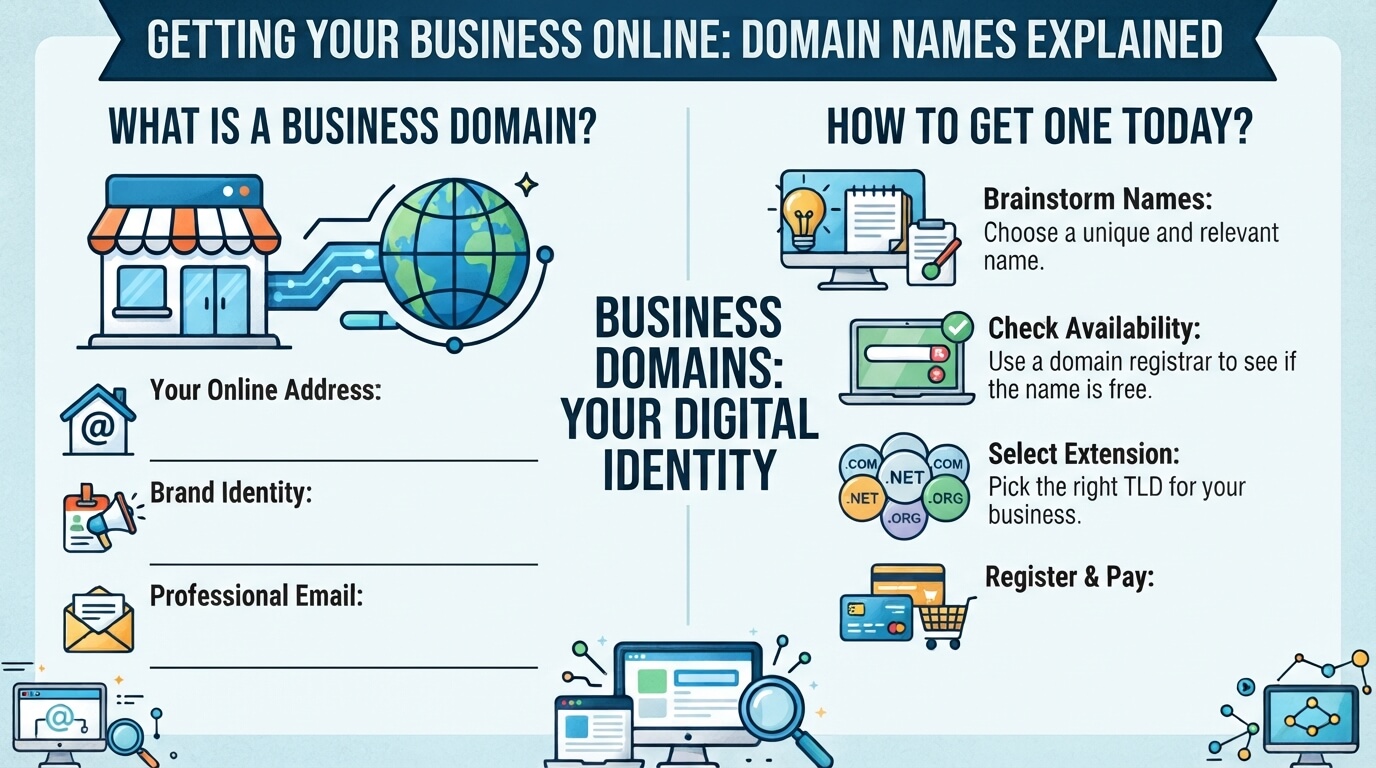
What is a business domain? It’s the web address your company uses online, such as yourbusiness.com. Customers type it into a browser to reach your website. It also becomes the ending of your email addresses, so you can use info@yourbusiness.com instead of a free Gmail account.
You can register a business domain name in about 15 minutes. The harder part is choosing the right name and avoiding surprise renewal fees. This guide covers both.
Reference image 1: parts of a domain name
Alt text: Diagram showing the parts of a domain name, including subdomain, second-level domain and top-level domain.
How a domain name is built
Every website lives on a server, and every server has a numeric IP address. Nobody wants to type a string of numbers. A domain name is the readable label that points to that address. For more background, see our guide on what domain names are and how they work.
Picture a shop on a busy street. The sign is your domain. The building behind it is your website. The street map that connects the two is the Domain Name System, or DNS.
A domain has two main parts:
- Second-level domain: the name you choose, like sweetcrumb in sweetcrumb.com.
- Top-level domain (TLD): the ending after the dot, like .com or .org. People also call it the domain extension.
You can add a subdomain in front, such as shop.sweetcrumb.com or blog.sweetcrumb.com. It costs nothing extra once you own the main domain.
How does a business domain name work?
When someone types your domain into a browser, the browser asks a DNS resolver where that name lives. The resolver checks a chain of servers: first the root, then the server for your extension (.com, for example), and finally the server that holds your records. That last server returns your website’s IP address, and the page loads.
All of this takes milliseconds, and visitors never see it. What you control are the DNS records. They tell the system where to send visitors and where to deliver email.
Reference image 2: DNS lookup flow
Alt text: Flow diagram of a DNS lookup from browser to resolver, root server, TLD server and authoritative name server.
Domain vs. web hosting vs. business email
People mix these up all the time, and some sellers bundle them, which doesn’t help. They are three separate things.
| Service | What it does | Example |
|---|---|---|
| Domain name | Your address | yourbusiness.com |
| Web hosting | Stores your website files and serves them to visitors | A shared hosting plan |
| Business email | Sends and receives mail from your domain | info@yourbusiness.com |
Owning a domain doesn’t give you a website or an inbox. You need hosting for the first and an email service for the second. If hosting is new to you, read how web hosting works before buying a plan. You can start with only the domain, which is a good way to claim your name early.
Why your business needs its own domain
A company with its own address looks more trustworthy than one using a free subdomain like yourshop.wordpress.com. A custom domain also:
- Makes you easier to remember and share.
- Lets you create role-based emails like sales@ and support@.
- Stays with you if you change your website builder or hosting company.
- Gives you something you own, instead of renting space on someone else’s platform.
One honest note on SEO: buying a domain doesn’t improve your Google rankings by itself. Rankings come from useful content, a fast site, and a good experience for visitors. The domain is the foundation, not a shortcut.
Which domain extension should you pick?
For most businesses, .com is the safe default. People expect it, and they often type it by habit even when your site uses something else.
Other options depend on your situation:
- .net: Started as a network-related extension. Now used by many kinds of businesses.
- .org: Usually linked to nonprofits and community groups.
- .biz: Meant for business use. It works if the .com is gone, but customers may trust it less.
- Country-code domains (ccTLDs): Such as .co.uk or .ca. They signal that you serve a specific country.
If you serve customers in Bangladesh, .com.bd is a strong local choice. It’s issued through BTCL, the registry for .bd domains. Some country extensions have eligibility rules, so check them before you pay. Registering a .bd name usually requires documents such as a trade license or ID, so allow extra time.
If your preferred .com is taken, don’t pad the name with hyphens or numbers. A shorter, clearer name on a different extension often beats an ugly .com.
How to choose a domain name for your business
A few rules cover most cases:
Keep it short. Short names are easier to type and say out loud. bloomflorist.com works. thebestflowerandgiftshopinyourtown.com doesn’t.
Use your business name. If you run Bright Path Coaching, try brightpathcoaching.com first. If it’s taken, add a simple word like your city, not random letters.
Make it easy to spell. Say the name to a friend. If they can’t type it correctly after hearing it once, simplify it.
Skip hyphens and numbers. They get lost in speech and cause typos.
Think about growth. downtowncupcakesonly.com becomes a problem the day you add coffee or move across town. freshbitefoods.com has room to grow.
Check trademarks. A domain being available doesn’t mean you can legally use the name. Search your country’s trademark database before you commit. Our guide on how to research a domain name before buying covers other checks worth doing, such as a name’s past history.
Check social handles. If @yourbusiness is free on the platforms you’ll use, grab it at the same time.
How to get a business domain today, step by step
- Pick your name and two backups. Your first choice may be taken.
- Search for availability. Use a registrar’s search box, or try a free domain lookup tool to see whether a name is open. Try other extensions if the .com is gone.
- Compare total cost. Look at the renewal price, not just the first-year deal. Check what privacy protection costs.
- Register. Create an account, enter accurate contact details, and pay. Watch for a verification email, since many registrars suspend domains whose contact details aren’t confirmed. If you choose Namecheap, here’s how to buy a domain name from Namecheap.
- Lock it down. Turn on two-factor authentication and auto-renewal. Save your recovery codes somewhere safe.
- Connect it to your website. Your host will give you nameservers or DNS records (an A record or CNAME) to enter at your registrar. Changes can take a few hours to spread. Then test both yourdomain.com and www.yourdomain.com.
- Set up email. Choose an email provider, then create your addresses. Add SPF, DKIM, and DMARC records. Together they prove your emails really come from you, which helps keep them out of spam folders and makes impersonation harder. Our email hosting setup guide walks through the process.
Register the domain under your business’s own account, with your own email address. Never let a freelancer or agency register it in their name. Whoever is listed as the registrant controls the domain.
Where to buy a business domain
Several registrars are worth comparing:
- Cloudflare Registrar: Sells domains at wholesale cost with no markup, so renewals cost the same as the first year. The trade-off is that domains must use Cloudflare’s nameservers, and it doesn’t offer email hosting.
- Porkbun: Also sells many domains close to cost and lets you point nameservers anywhere.
- Namecheap and GoDaddy: Well-known registrars with large extension lists. Both run first-year promotions, so read the renewal price before you check out.
- BTCL and authorized resellers (Bangladesh): The route for .bd and .com.bd domains. Resellers set their own prices and service fees, so compare a few.
Torn between two of these? Here’s a direct Cloudflare vs. Namecheap comparison. It also helps to know how ICANN, registrars, and registries differ, since the registrar is the company you actually deal with.
A practical trick: enter the same domain at two or three registrars and compare the three-year total, including renewal and privacy fees. That number tells you more than any headline price. Check the transfer rules too. If you ever move, you’ll need an EPP code from your current registrar.
How much does a business domain cost?
Here is what current sources show. Prices change, so confirm at checkout.
- .com: Roughly $10 to $20 a year, depending on the registrar. Cloudflare’s at-cost price is about $10.46 a year for both registration and renewal. Other registrars may run first-year promotions, then raise the price.
- .com.bd: BTCL’s published fees are Tk 700 to register and Tk 1,020 to renew, per year, before VAT. Some authorized resellers charge more, and some require a two-year minimum on first registration. One reseller, for example, lists Tk 1,265 for registration and Tk 1,840 for renewal.
- Business email: Google Workspace Business Starter costs $7 per user per month on an annual plan, or $8.40 on a flexible monthly plan, according to Google’s own pricing.
- Web hosting: Plans vary a lot, and introductory rates often jump at renewal. Our breakdown of how much web hosting costs shows what to expect.
- Premium domains: Short, keyword-rich names can cost hundreds or thousands of dollars. Most small businesses don’t need one.
Mistakes that cost people money
- Picking a long or confusing name that nobody remembers.
- Ignoring the renewal price.
- Skipping the trademark check.
- Registering the domain in someone else’s name.
- Leaving two-factor login off.
- Assuming hosting or email comes included.
- Letting the domain expire. A lapsed domain can take your site and email offline, and someone else may grab the name. The domain expiration timeline shows what happens after the date passes.
- Editing DNS records without reading the existing ones first. One wrong change can break your website or email.
- Buying extra extensions with no clear reason.
Frequently asked questions
Can I buy a domain without a website?
Yes. Registration just reserves the name. You can park it or put up a “coming soon” page.
Can I use a domain for email only?
Yes. You’ll need an email hosting service, but you don’t need a website.
Can I get a domain for free?
Some website builders include a free first-year domain with a paid plan. Renewal often costs more afterward. Free subdomains don’t count as owning your own address.
Does a domain include email hosting?
Usually not. Check the plan before you buy.
How long does registration last?
Typically one to ten years, depending on the registrar and extension. Some country domains have minimum terms. Turn on auto-renewal so it doesn’t lapse.
Can I change my domain later?
Yes, but plan it. You’ll need to set up redirects from the old domain, update your email addresses, and fix links. A sloppy move can hurt your search traffic.
Who owns the domain after I register it?
The registrant named in the records, under the registrar’s terms. Make sure that’s your business.
Start with the name, then protect it
Choose a short name that matches your brand, compare the total cost across registrars, and register it under your own account. Then turn on two-factor login and auto-renewal. Do those three things and the rest is easy to fix later.